Book Printing Technology in Kenya Explained
PrintShopKE Team
The Technology Behind Professional Book Printing in Kenya — And Why It Matters for Your Project
Published by PrintShopKE | Category: Printing Knowledge | Reading time: ~8 minutes
Introduction: It's Not Just Ink on Paper
When you hand over a manuscript to a print shop, a lot more happens than pressing a button. The finished book in your hands — crisp text, vivid cover, flat-lying pages — is the result of a carefully sequenced chain of technology decisions made long before the press starts running.
Understanding those decisions helps you, as an author, publisher, or business owner in Kenya, ask the right questions, make better specifications, and ultimately get a better product. Whether you're printing 50 copies of a children's storybook in Nairobi or 2,000 copies of a corporate training manual to distribute nationwide, the technology used determines everything from colour accuracy to how long your book survives daily handling.
This guide breaks down the core technologies used in modern book printing — and shows you how they apply when you order book printing services in Kenya through PrintShopKE.
Table of Contents
Digital Printing vs Offset Printing — Which Is Right for Your Book?
How PrintShopKE Applies These Technologies for Kenyan Authors and Businesses
1. Digital Printing vs Offset Printing — Which Is Right for Your Book? {#1-digital-printing-vs-offset-printing}
The two dominant technologies in commercial book printing are digital printing and offset (lithographic) printing. Each has a distinct use case, and professional print shops use them strategically based on your order volume and turnaround requirements.
Digital Printing
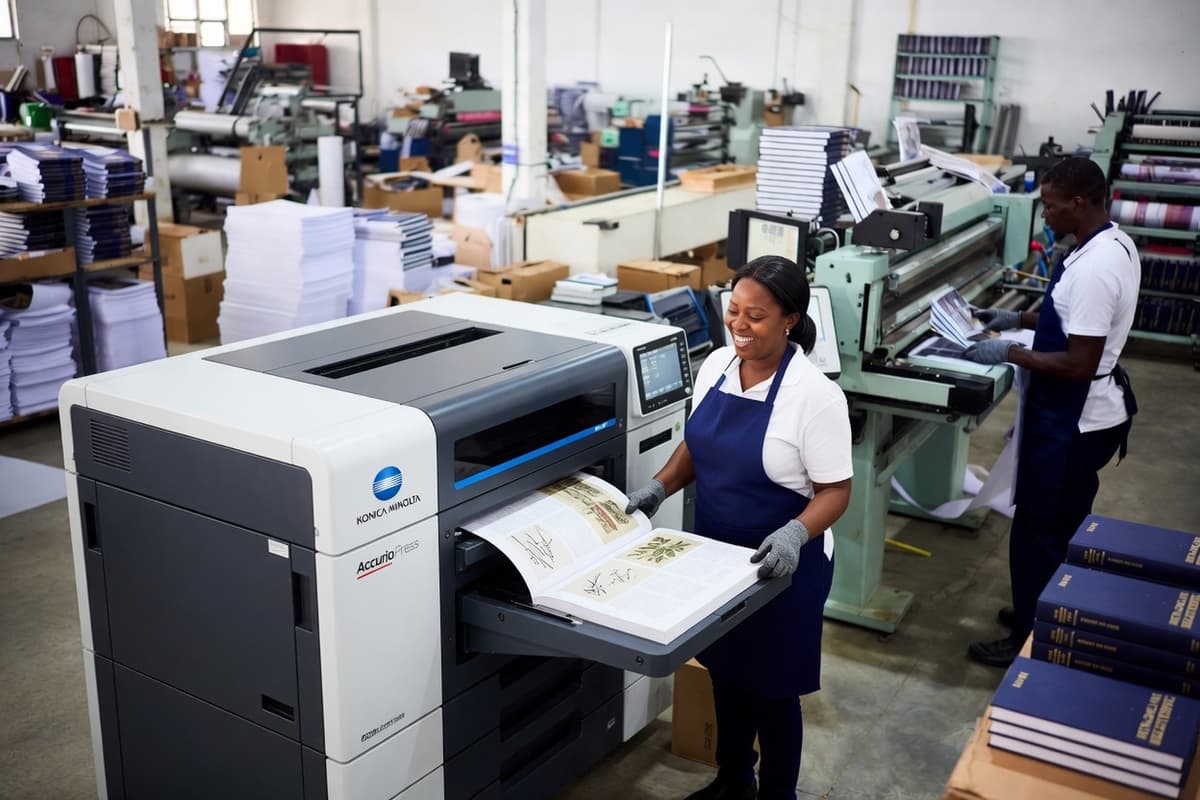
Digital printing works like a high-powered office printer — your file is sent directly to the press with no physical plates required. Modern digital presses use either toner-based (electrophotographic) or inkjet-based engines that can produce sharp, consistent output on demand.
Advantages for book printing:
No minimum quantity — viable for as few as 1 copy
Fast turnaround — files go to press almost immediately
Cost-effective for short runs (under 500 copies)
Variable data capability — each copy can carry unique content (useful for personalised workbooks or certificates)
Easy reprints with no plate re-making costs
Limitations:
Per-unit cost is higher than offset at large volumes
Colour gamut and ink density can differ slightly from offset
Digital printing is the dominant technology for self-publishing authors, schools ordering term materials, and businesses printing training manuals in Kenya's market today.
Offset Printing
Offset (lithographic) printing uses physical plates — typically aluminium — that carry your image. Ink is transferred from the plate to a rubber blanket, then onto the paper (the "offset" step). It is the industry standard for high-volume, high-quality runs.
Advantages for book printing:
Superior colour accuracy and consistency across thousands of copies
Lower per-unit cost at scale (typically 1,000+ copies)
Wider range of paper stocks and specialty inks (Pantone, metallics, spot UV)
Better handling of very fine detail and photographic reproduction
Limitations:
Higher setup cost (plate-making fees)
Minimum quantities apply (rarely economical below 500 copies)
Longer turnaround due to make-ready time
Offset printing is the right choice for textbook publishers, religious organisations printing large runs, and businesses that need consistently branded output across bulk quantities.
💡 PrintShopKE uses the appropriate technology for your volume and budget. For most Kenyan independent authors and SMEs, digital printing delivers the best value. Get a quote for your specific project here.
2. Prepress Technology: From Your File to a Print-Ready Plate {#2-prepress-technology}
Prepress is everything that happens between you submitting a file and the press starting to run. It is one of the most technically demanding phases and where a lot of quality issues originate — especially when working with files not prepared for print.
Computer-to-Plate (CTP) Technology
Traditional printing required a film intermediate step — your design was output to film, which was then used to expose a plate. Modern offset presses use Computer-to-Plate (CTP) technology, where the digital file is imaged directly onto the aluminium plate using a laser. This eliminates the film step entirely, producing sharper plates, tighter registration, and less waste.
CTP technology has dramatically improved the quality baseline for offset printing since the 1990s and is now standard in any professional print facility.
Imposition and Digital Preflighting
Imposition is the process of arranging your book pages in the correct order on a printing sheet so that when the sheet is folded and trimmed, the pages appear in sequence. A 200-page book might be imposed 16 pages per sheet (called a "signature"), requiring careful mathematical arrangement.
Preflighting is the automated checking of your submitted file for print-readiness. Professional preflighting software checks for:
Correct colour mode (CMYK vs RGB — more on this in Section 7)
Sufficient image resolution (minimum 300 DPI for print)
Proper bleed and margin setup
Missing or embedded fonts
Transparency flattening issues
Correct document dimensions
Submitting a properly preflighted file reduces delays and the risk of print errors significantly. PrintShopKE's team performs preflighting on every submitted file before going to press.
Recommended File Specifications for Book Printing in Kenya
Specification | Requirement |
|---|---|
File format | PDF/X-1a or PDF/X-4 (preferred) |
Colour mode | CMYK (not RGB) |
Image resolution | Minimum 300 DPI |
Bleed | 3mm on all sides |
Fonts | Embedded or outlined |
Margins (safety area) | Minimum 5mm from trim edge |
3. Ink Technology in Book Printing {#3-ink-technology}
The ink used in book printing is not a single technology — it varies significantly between press types and has a direct impact on print quality, longevity, and environmental footprint.
Offset Inks
Offset inks are thick, paste-like formulations that are transferred in a very thin, precise film. They dry through a process called oxidative polymerisation (exposure to air triggers a chemical hardening reaction) or through UV curing (ultraviolet light instantly cures the ink). The result is a very sharp, dense ink layer.
Soy-based offset inks are increasingly common and are used at PrintShopKE for environmentally conscious print runs. Soy inks produce vivid colours, are easier to de-ink during paper recycling, and reduce volatile organic compound (VOC) emissions compared to petroleum-based alternatives.
Toner-Based Digital Inks (Electrophotographic)
Digital presses using electrophotographic technology (like the HP Indigo or Konica Minolta production presses) use dry toner or liquid ElectroInk. The toner particles are electrostatically attracted to the paper drum and fused under heat. This creates a very thin, uniform layer that is sharp and consistent across short runs.
Inkjet Pigment Inks
High-volume digital inkjet presses (like the Canon ProStream or Ricoh Pro VC series) use aqueous pigment inks that are absorbed into the paper fibre. This produces a soft, natural look ideal for text-heavy books. These presses are increasingly popular for printing educational materials and novels in developing markets.
No-Bleed-Through Ink Technology
A common issue in book printing is ink bleed-through — where ink soaks through to the reverse side of the page, making it difficult to read. Professional presses address this through controlled ink volume, the correct ink-paper pairing, and modern penetration-controlled ink formulations that bind quickly to the paper surface without saturating through.
This is particularly important for interior pages where both sides carry text — a characteristic of all well-printed books and something PrintShopKE ensures on every job through correct ink-paper specification.
4. Paper and Substrate Technology {#4-paper-and-substrate-technology}
Paper is not passive — it is an active participant in print quality. Different paper substrates interact with ink, light, and binding adhesives in very different ways, which is why paper selection is one of the first decisions in any book printing project.
For a detailed breakdown of the specific paper grades available for your book project — including bond paper, art paper, and cover board options — see PrintShopKE's book printing page, which outlines how each paper type performs for different book categories.
From a technology standpoint, the key paper properties that affect print quality are:
Basis Weight (GSM)
GSM (grams per square metre) is the standard measure of paper weight. Heavier GSM papers are more opaque (reducing show-through), more durable, and carry ink better. Common weights in book printing:
Paper Use | Typical GSM Range |
|---|---|
Interior pages (novels, manuals) | 70–90 GSM |
Interior pages (illustrated books) | 100–130 GSM |
Soft covers (paperback) | 200–250 GSM |
Hard covers (case binding) | 300+ GSM board |
Coating and Surface Finish
Paper can be uncoated (like bond paper, which has a slightly rough surface that absorbs ink readily — ideal for text) or coated (where a clay-based layer creates a smooth surface for sharper image reproduction — ideal for photographs and graphics).
Within coated paper, the finish can be:
Gloss coated — high reflectivity, vibrant colours, ideal for image-heavy books
Matte coated — low reflectivity, softer appearance, easier to read in bright light
Silk/satin coated — a middle ground between gloss and matte
Opacity
Opacity determines how much light passes through the sheet. Low-opacity paper allows show-through from the reverse side, which is distracting in text-heavy publications. High-opacity paper is essential for books with text printed on both sides of every page — which is essentially every book.
Recyclability and Sustainability
Modern paper mills produce recycled content papers and FSC-certified papers (Forest Stewardship Council) that meet international sustainability standards. These papers perform comparably to virgin fibre papers on press and are increasingly preferred by authors and organisations with environmental commitments.
5. Binding Technology: How Your Book Is Held Together {#5-binding-technology}
Binding technology is what determines whether your book survives one reading or a thousand. The method chosen depends on the book's thickness, its intended use, and your budget.
PrintShopKE offers multiple professional binding options — here's the technology behind each one:
Perfect Binding (PUR Adhesive)
Perfect binding is the method used for virtually all paperback novels, textbooks, and corporate publications. The pages (called the "book block") are gathered, the spine edge is roughened (notched or ground), and a Polyurethane Reactive (PUR) adhesive is applied. The cover is then wrapped around the spine and pressed.
PUR adhesive is the modern standard because it:
Creates a stronger bond than traditional EVA hot-melt adhesives
Remains flexible under temperature variation (important in Kenya's climate)
Allows books to open flatter without cracking the spine
Bonds effectively to coated papers that EVA adhesives struggle with
The result is the familiar square-spine paperback book.
Saddle Stitch Binding
Saddle stitch uses wire staples inserted through the folded spine of the book block. The name comes from the "saddle" — a triangular support the booklet straddles during stapling.
This method is only suitable for books up to about 100 pages (25 sheets of folded paper) because beyond that the spine becomes too thick and the pages begin to "fan" unevenly. It is cost-effective, fast, and ideal for booklets, event programmes, and thin manuals.
Wire-O (Double-Loop Wire) Binding
Wire-O uses a double-loop wire spine threaded through punched holes along the spine edge of the pages. The wire is then mechanically closed (crimped) to secure the pages.
The key functional advantage of Wire-O is 360-degree page rotation — pages can fold completely back on themselves without straining the spine. This is why it's the standard for notebooks, workbooks, field manuals, and training materials that are used flat on a desk or held with one hand.
Case Binding (Hardcover)
Case binding is the technology behind hardcover books. The interior pages are sewn into signatures (folded sections), the signatures are glued together at the spine, and the resulting book block is attached to a rigid case (the hardcover) using an endpaper and a cloth or paper hinge.
This is the most durable binding method — hardcover books can withstand decades of regular use — and is used for premium publications, coffee table books, and reference works.
Lay-Flat Binding
A premium variant of perfect binding, lay-flat uses a special flexible adhesive system that allows the book to open completely flat without the spine cracking. It is particularly valuable for photography books, cookbooks, and any book where seeing two full pages as a single spread is important.
6. Finishing Technology: The Details That Elevate Quality {#6-finishing-technology}
Finishing refers to the processes applied after printing and binding that enhance the book's appearance, durability, and feel. These technologies are what distinguish a professional book from an amateur one.
Lamination Technology
Lamination involves bonding a thin plastic film to the cover surface using heat and pressure (thermal lamination) or adhesive (cold lamination). The two primary finishes are:
Gloss lamination — a shiny, reflective surface that makes colours pop and protects against moisture and handling
Matte lamination — a flat, non-reflective surface with a premium, tactile feel popular for literary fiction and corporate publications
Lamination dramatically increases the cover's resistance to scuffing, moisture, and UV fading — critical for books that will be displayed, handled frequently, or stored in varied conditions.
Trimming and Cutting Technology
After printing and binding, the book block is trimmed on three sides (top, bottom, and open edge) using a three-knife trimmer or guillotine cutter. Modern cutters use computer-controlled precision to ensure perfectly square, consistent trim across every copy in a run. This is the step that gives your book its final, clean-edged dimensions.
Embossing and Debossing
Embossing creates a raised design on the cover by pressing the material between a die and counter-die. Debossing creates a recessed impression. Both are used for premium books, hardcovers, and branded corporate publications where texture adds perceived value.
Spot UV Coating
Spot UV applies a thick, high-gloss coating to selected areas of a cover — typically the title or logo — while leaving the rest matte. The contrast between the coated and uncoated areas creates a striking visual and tactile effect. It is one of the most requested finishing options for premium publications and branded content.
7. Colour Management: Why Your Colours Need to Be CMYK-Ready {#7-colour-management}
Colour management is frequently misunderstood by first-time print buyers and is one of the most common sources of disappointment when printed books don't match on-screen expectations.
The RGB vs CMYK Problem
Computer screens, smartphones, and tablets display colour using RGB (Red, Green, Blue) light, which can produce a very wide range of vivid colours — particularly bright blues, greens, and purples. Print presses, however, use CMYK (Cyan, Magenta, Yellow, Key/Black) inks, which work by absorbing light rather than emitting it. The CMYK colour space is significantly smaller than RGB — meaning many colours you see on screen simply cannot be reproduced in print.
When an RGB file is sent to a CMYK press without proper conversion, the press makes an automatic (often poor) conversion that can result in:
Muted, dull colours
Unexpected colour shifts (bright purples turning muddy brown)
Inconsistent reproduction across pages
Always convert your book files to CMYK before submitting for print. Your graphic designer should handle this, or PrintShopKE's design team can assist.
ICC Colour Profiles
Professional print shops use ICC (International Colour Consortium) colour profiles — standardised digital descriptions of a device's colour behaviour — to ensure predictable colour output. Common print profiles include FOGRA39 (European offset standard) and SWOP (North American offset standard).
When your file is prepared with the correct ICC profile embedded, the press operator can match your intended colours with precision. This is particularly important for brand books, photography publications, and any project where exact colour reproduction matters.
Pantone (Spot Colour) vs Process (CMYK) Colour
For projects where a specific colour must be exact — like a corporate brand colour — Pantone spot inks (pre-mixed, standardised ink colours) offer more precision than CMYK mixing. Spot colours require an additional press unit but guarantee consistent, vibrant reproduction that CMYK cannot always match.
8. File Format Technology: Sending the Right Files for Print {#8-file-format-technology}
The file format you submit has a significant impact on print quality. Unlike digital display, print is unforgiving of low-resolution images, incorrect colour modes, and improper file structures.
PDF/X: The Professional Standard
PDF/X is a subset of PDF designed specifically for print production. It enforces requirements like CMYK colour, embedded fonts, and correct bleed — preventing many common errors before they reach the press. PDF/X-1a is the most widely supported and safest format to submit.
Image Resolution: Why 300 DPI is the Minimum
DPI (dots per inch) describes how much image data is packed into each inch of print. At normal reading distance:
72–96 DPI — screen resolution, far too low for print (will appear pixelated)
150 DPI — passable for large-format printing viewed at distance
300 DPI — the professional minimum for books and standard print
600 DPI+ — used for very fine detail (technical line art, engineering drawings)
A common mistake is saving an image from the internet (typically 72 DPI at screen size) and placing it into a book layout. Even if it looks fine on screen, it will print blurry. Always source or create images at 300 DPI at their intended print size.
Native Design Files: InDesign, Illustrator, and Photoshop
Professional book layouts are typically created in Adobe InDesign (the industry standard for multi-page documents), with images from Photoshop and logos/graphics from Illustrator. These applications produce print-ready, CMYK-correct, properly bleed-set files that export cleanly to PDF/X.
PrintShopKE accepts PDF, AI, PSD, EPS, INDD, JPG, and PNG files, with PDF/X being the recommended submission format for books.
9. How PrintShopKE Applies These Technologies for Kenyan Authors and Businesses {#9-printshopke-and-kenyan-authors}
Understanding the technology is useful — but what matters most is working with a print partner who applies it correctly for your specific project.
PrintShopKE's book printing service is built around the needs of Kenyan authors, schools, businesses, and organisations. Here is how the technology translates into practical advantages:
Digital preflighting on every job — your file is checked before printing, catching issues that would otherwise result in wasted copies and delays.
Correct ink-paper pairing — the right ink formulation is matched to your chosen paper stock, ensuring clean, non-bleed-through results on interior pages.
Professional binding for your use case — whether perfect binding for a novel, Wire-O for a workbook, or saddle stitch for a programme booklet, the binding technology is matched to your book's purpose and page count.
Lamination finishing for covers — matte and gloss lamination options protect your cover and give it a professional, durable finish suited to Kenya's handling and storage conditions.
Fast, accurate turnaround — digital printing technology enables same-day and next-day turnaround for Nairobi orders, with 24–48 hour delivery to Mombasa, Kisumu, Nakuru, and Eldoret.
M-Pesa payment — straightforward, familiar payment for Kenyan clients without the complexity of international payment systems.
If you're ready to put this knowledge to work, get a quote for your book printing project on the PrintShopKE booking page — custom quotes are returned within 2 hours.
10. Frequently Asked Questions {#10-faqs}
Q: What's the difference between digital and offset printing for books in Kenya? Digital printing is cost-effective and fast for short runs (under 500 copies) with no minimum order. Offset printing is more economical and delivers superior consistency for large runs above 1,000 copies. For most self-publishing authors and SMEs in Kenya, digital printing offers the best combination of quality, speed, and price.
Q: What file format should I submit for book printing? Submit a PDF/X-1a file with CMYK colour, embedded fonts, 300 DPI images, and 3mm bleed on all sides. PrintShopKE also accepts AI, PSD, INDD, JPG, and PNG, but PDF/X is strongly recommended for books to avoid prepress errors.
Q: Why do my printed colours look different from my screen? Screens use RGB colour, which can display colours that CMYK print inks cannot reproduce. Always work in CMYK mode in your design application and use a calibrated soft-proof to preview how your colours will appear in print. If exact brand colour accuracy is critical, discuss Pantone spot colour options with PrintShopKE.
Q: What is the minimum resolution for images in a printed book? 300 DPI at the intended print size is the professional minimum. Images sourced from websites are typically 72 DPI and will appear blurry in print. Always use high-resolution photography and graphics in your book layouts.
Q: What binding method is best for a 200-page novel? Perfect binding (using PUR adhesive) is the standard for novels and paperback books above 100 pages. It produces a professional square spine, is highly durable, and is the most cost-effective binding method for this page count.
Q: Can I get an eco-friendly book printing option? Yes. PrintShopKE offers printing on recycled paper stocks using soy-based inks for clients seeking a more sustainable publishing option, without compromising on print quality.
Conclusion: Technology in Service of Your Story
Modern book printing technology — from CTP plate-making and digital inkjet presses to PUR adhesive binding and matte lamination finishing — exists to serve one purpose: making your content look its best in physical form.
Knowing the basics of these technologies helps you communicate more effectively with your printer, make smarter specification decisions, and understand what you're paying for. Whether you're printing a debut novel, a school textbook, a corporate manual, or a children's storybook, the technology used at each stage of production directly determines the quality of the final book in your reader's hands.
Ready to print your book in Kenya? Browse PrintShopKE's professional book printing services — with prices starting from KES 150 per copy, fast turnaround across Kenya, and expert guidance from file to finished book.
Related Reading:
PrintShopKE is Kenya's trusted online print shop, serving authors, schools, and businesses across all 47 counties. Located in Westlands, Nairobi. Call/WhatsApp: 0746174084 | orders@printshop.ke